
Brazil National Team: 10 surprising facts you (probably) didn't know

Updated: Oct 9
Throughout its history, the Brazil national team has collected titles, records, unforgettable figures and events that go beyond the boundaries of soccer. Some of these stories are known around the world; others, however, may surprise even the most passionate fans. Get ready to discover facts that help explain why the Seleção Canarinho (A nickname inspired by the canary—a bird typically predominantly yellow) holds such a special place in Brazilian culture.

1. The only team to have played in every World Cup
The first World Cup was held in 1930, in Uruguay. Since then, Brazil has been the only national team to take part in every tournament. Even during periods of major change in international soccer, the Brazilian team has never missed the sport's biggest competition.
This constant presence has helped build one of the most respected histories in world soccer. In every generation, Brazil has been represented by players who became symbols of the country.
2. The country with the most World Cup titles
Besides being the only team to appear at every World Cup, Brazil is also the most successful nation in the tournament's history. The team has won five titles: 1958, 1962, 1970, 1994 and 2002.
Each triumph had its own stars. Pelé shone in the 1958 and 1970 victories; Garrincha was key in 1962; Romário and Bebeto led the 1994 campaign; and Ronaldo was the standout of the fifth title, in 2002.
3. Two campaigns with a perfect record
Of the five winning campaigns, two ended with a perfect record: the 1970 and 2002 teams won every match they played.
In 1970, in Mexico, Brazil won all six games of the tournament, including a 4–1 victory over Italy in the final. In 2002, held in South Korea and Japan, the team won all seven matches on the way to its fifth title, beating Germany in the final.
4. Pelé was the youngest champion

Pelé was just 17 years old when he won the 1958 World Cup in Sweden. To this day, he remains the youngest player to win the tournament.
In that competition, "O Rei do Futebol" (The King of Soccer) scored six goals, two of them in the final against Sweden. His performance introduced the world to an extraordinary talent and kicked off the career of one of the greatest athletes in history.
5. Cafu has played more World Cup matches than any other Brazilian
Right back Cafu is the Brazilian player with the most World Cup appearances. In total, he played 20 matches between 1994 and 2006.
He took part in four tournaments and started in the finals of 1998 and 2002. When Brazil won its fifth title, Cafu lifted the trophy as captain, cementing his place in the team's history even further.
6. The Brazil Team's biggest crowd at the Maracanã
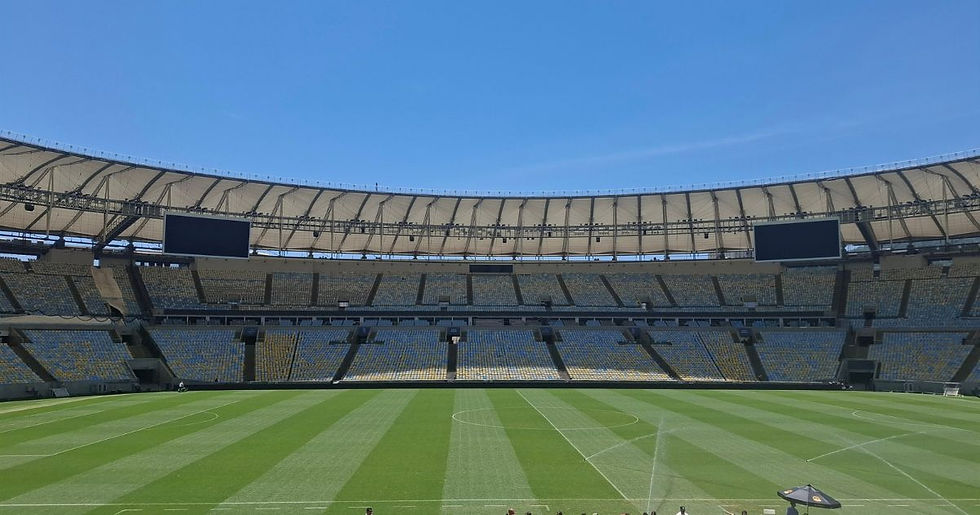
On August 31, 1969, Brazil and Paraguay met in a 1970 World Cup qualifier at the Maracanã. The match drew the largest paying crowd in the stadium's history: 183,341 people.
Brazil won 1–0, with a goal by Pelé, and secured a place at the World Cup in Mexico. The following year, the team would go on to win its third title with one of the most admired squads of all time.
7. From the Maracanazo to the Unforgettable 7–1
Despite so many victories, the Brazil national team has also suffered defeats that left a lasting mark. The oldest is the so-called Maracanazo (roughly, "the Maracanã blow"), which took place in the final of the 1950 World Cup, at the Maracanã itself. Brazil needed only a draw, but lost to Uruguay 2–1, in front of a crowd that expected to celebrate the title.
More than six decades later came another traumatic result: the 7–1 loss to Germany in the 2014 World Cup semifinal, played in Brazil. The scoreline became a popular expression. Today, dar um 7 a 1 ("to give a 7–1") can mean beating someone by a huge margin, but it can also stand for an unexpected disaster, a humiliation or a string of bad events.
8. Leônidas da Silva's barefoot goal

At the 1938 World Cup in France, Brazilian player Leônidas da Silva was part of an unusual scene. During the match against Poland, played in heavy rain, he lost one of his boots.
Even barefoot, the forward kept playing and scored a goal. Brazil won the match 6–5 in extra time. Leônidas finished that World Cup as top scorer and became known by the nickname Diamante Negro ("Black Diamond").
9. When Bayern Munich wore the colors of the Amarelinha
The influence of Brazilian soccer also crossed the Atlantic. Motivated by the winning mystique of the Brazil national team, which was already the most successful World Cup nation at the time, Bayern Munich adopted a temporary kit inspired by the Amarelinha ("Little Yellow One," the nickname for Brazil's yellow shirt) in the early 1980s.
The reason was tied to a specific problem: the German club had not managed to win away at Kaiserslautern in more than eight years. The Fritz-Walter-Stadion was considered a tough, hostile place for visiting teams, and the streak bothered a Bayern side that was already one of the most successful clubs in Europe.
On November 26, 1983, Bayern took the field in a yellow shirt and blue shorts, a clear nod to the Brazil team. The result could not have been more symbolic: a 1–0 win over Kaiserslautern, ending the long drought. The club wore the kit in a few other matches, but later went back to its traditional design.
10. The "Game for Peace" in Haiti
On August 18, 2004, Brazil and Haiti played a historic friendly at the Sylvio Cator Stadium in Port-au-Prince. The match became known as the Jogo da Paz ("Game for Peace") and took place during a period of serious political crisis and civil unrest in the country.
The Brazil team won 6–0. Ronaldinho Gaúcho scored three goals, Roger Flores added two and Nilmar completed the scoreline. The Brazilian delegation was welcomed with great excitement, and the players even paraded in armored vehicles. There was also a campaign to exchange weapons for tickets.
Seven players who had won the World Cup two years earlier took part in the friendly: Belletti, Juan, Roque Júnior, Roberto Carlos, Gilberto Silva, Ronaldinho Gaúcho and Ronaldo. Because of the event's symbolic importance, the CBF (Brazilian Football Confederation) received FIFA's Fair Play Award.
Far beyond soccer: memories that stay

These ten facts show that the Brazilian National Team is much more than just a sports team. It is part of the emotional memory of millions of people and introduces Brazil to the world through its colors, its players, and its stories.
I have a special memory of my own related to the team. In 1995, a year after the world tetra championship, I was on vacation with my family at a shopping mall in Rio de Janeiro. Inside a department store, we recognized the player Branco, who had been part of the 1994 victory. We went over to talk to him, congratulate him, and ask for autographs.
I was very young, but I remember perfectly how kind and approachable he was. Branco talked to us and gave everyone his full attention so naturally. Today, I cherish this memory because it also seems to portray a different era of soccer. Nowadays, it can be much harder to find a freshly crowned world champion casually walking through a mall and reacting with such spontaneity to fans. Soccer has changed, but some memories remain unforgettable.
In the end, the yellow jersey represents much more than a team. It carries joy, talent, hope, and emotion. Even people who have often never visited Brazil recognize its colors and associate the Amarelinha with the Brazilian way of living soccer.
And now that you know ten fun facts about the Brazilian National Team, here is my invitation: how about getting a close-up look at some of the jerseys that helped build this history and discovering details of one of the most iconic stadiums in the world? Watch the video where I visit the Maracanã stadium and dive even deeper into the culture and memories of Brazilian soccer. See you there! 😊


About the author
I'm Audrey Lyra a Portuguese teacher for foreigners with over ten years of experience, and the creator of this blog. My purpose is to connect you to the language and culture of Brazil, making your learning journey easier.


